
Pulse
Sex ed for real life. Proven effective.
With Pulse, young people access sexual health education on their own time and on their own terms. No teacher or classroom required: Pulse is a web-based mobile health app.
Pulse uses interactive, multimedia features to support healthy sexual behavior. Always sex-positive and culturally- and age-appropriate, Pulse educates young people about birth control, healthy relationships, sexual health and anatomy, pregnancy, and clinical services.
And it works. Proven effective with a randomized control trial, Pulse is officially an evidence-based program.
All Ears: Quick Look
Pulse is a web-based mobile health app that uses interactive, multimedia features to support healthy sexual behavior.

Sex-Positive & Culturally & Age-Appropriate
Sexual & Reproductive Health Intervention

Self-Led
100% Web-Based & Mobile-Optimized
Built with Behavior Change Theory
Proven Effective, Evidence-Based, & Eligible for Replication
Getting In Sync: Sex Ed for Real Life
Over the last decade, Healthy Teen Network and our partners developed Pulse as a sexual and reproductive health intervention with funding from the U.S. Department of Health and Human Services.
Unlike many other programs, Pulse is web-based and mobile-optimized—built to run smoothly on smartphones, with no downloads required.
Also, unlike many other programs, Pulse is completely self-led, giving young people control over when, where, and how they engage. Users browse and complete the content on their own time. This asynchronous access removes the burden of having a trained facilitator available.
Always sex-positive and culturally- and age-appropriate, Pulse uses behavior change theory to educate young people on topics like birth control and pregnancy, healthy relationships, clinical services, and more.
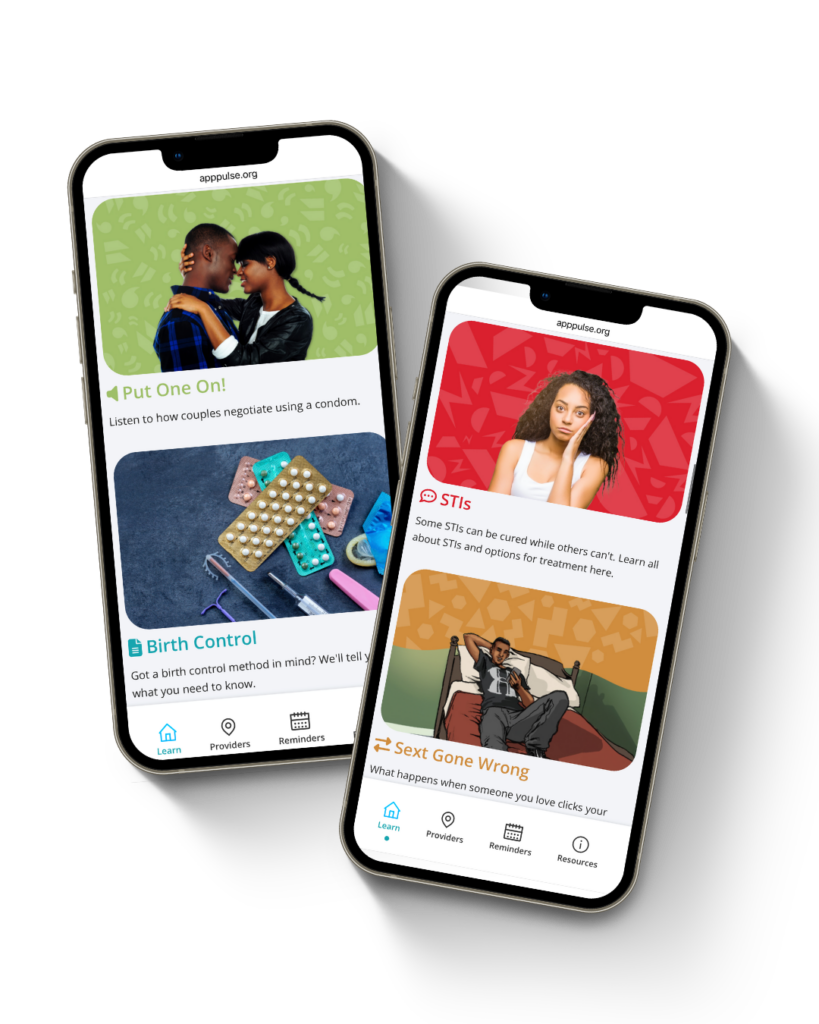
We carefully designed every part of Pulse, guided by young people’s input on the content every step of the way. Pulse offers a variety of media—videos, web comics, quizzes, and more—that support diverse learning styles. And its interactive clinic finder links young people to care in their own community.
And importantly, Pulse was proven effective through a randomized controlled trial—and now stands among the Teen Pregnancy Prevention Program’s evidence-based interventions with demonstrated positive outcomes. And so, it’s eligible for replication in communities across the country.
All this together is what gives Pulse its unique beat.

Tuning In: Meeting Young People Where They Are
From the very beginning, we set out to build an intervention that puts sexual health information in the hands of young people—anytime, anywhere.
According to the Pew Research Center, 95% of young people today have access to a smartphone. And nearly half say they’re online almost constantly. Latinx and Black young people, in particular, report high levels of connection. (Pulse was created with these communities in mind, though all young people can benefit from Pulse today.)
Creating an intervention for phones isn’t just about going where young people spend their time—it’s also about honoring how and where they feel most comfortable taking in information, especially when the topics are personal, such as health and relationships.
What’s more, this approach allows us to expand our reach. Many sexual and reproductive health efforts often focus on school-age populations and often take place in schools or after-school programs. However, Pulse can reach older teens and young adults, as well as young people outside of the structured school environment, such as through clinical or community programs.
By leaning into the rhythms of real life, Pulse meets young people in a space they already love and trust—right alongside YouTube, TikTok, Instagram, and Snapchat.
Smartphones
Constantly
YouTube
TikTok
SnapChat
Beat by Beat: What Makes Up Pulse?
Pulse’s content is comprehensive, culturally sensitive, LGBTQ+-sensitive, and linguistically appropriate. It addresses general knowledge on sexual health, common attitudes, social norms, and behavioral expectations, as well as helps build basic skills and self-efficacy in contraceptive and condom use.
Anatomy & Physiology
“Know Your Body” includes interactive content to help users learn about anatomy and physiology. Videos from experts explain the menstrual cycle and how the body reacts to sex. Users can also take fun quizzes to help with planning and making healthy choices.
Sexually Transmitted Infections (STIs)
“STIs” has an interactive gallery of what is and isn’t an STI. Here, users can learn more about each STI and other diseases, as well as treatment options, in a non-stigmatizing way.
Healthy Relationships
Through storytelling in the “Get Personal,” users can see different relationships modeled and are asked to choose a reaction to these scenarios—sort of like a choose-your-own-adventure. Users can also explore multiple options in these scenarios to learn how different reactions might affect a relationship.
Birth Control Options
In “Know Your Options,” users can take a quiz to figure out which birth control option suits them best and can read about how each contraceptive works. The guide connects to the Reminder feature, which allows users to schedule reminders to take birth control. There are also video scenarios that walk through how to get access to birth control.
Pregnancy
In “Make a Plan,” users can find a quiz to consider if they may be pregnant, a guide to how pregnancy tests work, and a video from an expert explaining how a person gets pregnant. The “Am I Pregnant” quiz also gives users the option to use the clinic locator function to find care if needed.
Clinic Locator
Lastly, the clinic locator map—powered by Bedsider—can help users find clinics and providers near them. Users can also set appointment reminders in their calendars to make sure they don’t forget.
It’s Unique Beat: Core Components
Pulse‘s core components include its content, pedagogy, and implementation.

Content
Pulse features a wide range of diverse media, including short live-action videos, animations, comics, audio conversations, self-assessments with tailored responses, brief text, and interactive graphics.
Pulse content…
- Includes information that is comprehensive, medically accurate, culturally sensitive, LGBTQ+-sensitive, and linguistically appropriate;
- Addresses general knowledge on sexual health;
- Addresses common attitudes, social norms, and behavioral expectations; and
- Builds basic skills and self-efficacy in contraceptive and condom use.

Pedagogy
Pulse uses self-directed, interactive web content that users can consume independently. It shares succinct content and relatable media, using humor when appropriate, to convey complex health information.
It also offers linkages to local sexual and reproductive health clinics and providers, and programmable reminders for effectively using contraception and remembering appointments.
Implementation
Pulse provides online content via a web app, ensuring near-100% fidelity in program implementation.
Pulse is best viewed on a mobile phone or tablet (not on a large laptop or computer screen). Users do not need to download any program, app, or plugin to view the content.
To access Pulse, users get unique logins, and all login information is stored outside of the web app, ensuring private and confidential browsing.
What's the Vibe? Young People Tell It Like It Is
Yes, young people like it! But don’t just take our word for it!
Straight from the participants, we heard that the young people in our study liked Pulse. The vast majority of them said Pulse was easy to use, and its information was easy to understand and interesting.
Understand
the content
answers
Mic Drop: Pulse Works
Pulse is proven effective and is widely recognized as an evidence-based program in the Teen Pregnancy Evidence Review (TPPER): Evidence-Based Program.
To evaluate Pulse, we worked with our research partners at Child Trends on a two-arm randomized controlled trial. Between 2016 and 2019, over 2,000 mostly Black and Latinx young women aged 18–20 participated.
So, what did we learn? Well, we learned that Pulse works.
Learn more about the behaviors Pulse has been proven effective at changing in our evaluation reports and related resources.
Greater knowledge about contraception
Greater self-efficacy on using contraception
Less unprotected sex
(sex without a hormonal/LARC Method)

Rhythm in Reach: Doing Pulse
So, who’s Pulse for?
Pulse was designed for and tested with mostly Black and Latinx young women, and it was proven effective in that population. That said, it can work more broadly; however, it’s important to note that we don’t have the same rigorous evaluation for other groups. That said, we have tested a similar program with younger youth—ages 14 to 16—and found that to be effective as well.
No matter who you’re working with, one of Pulse’s biggest strengths is that it’s completely self-directed—no facilitator required. Young people can use it independently, choosing the topics that matter most and moving at their own pace.
But that doesn’t mean adults and organizations don’t have a role to play.
- Clinics might add a QR code to their intake forms or posters, so young people can explore the app while they wait.
- Schools might purchase access and make it available during health or physical education classes or use it to complement classroom instruction.
- In community or faith-based spaces, you might hold small-group sessions where everyone explores the app individually, then comes together to discuss what stood out.
And of course, we know that you’ll think of even more creative ways to bring Pulse into your work. There’s no one-size-fits-all model—but there’s almost always a way in.
Regardless of your setting, if you need more help figuring out how best to implement Pulse for your community, we are here for you.
Sound Check: Sneak a Peek
With Pulse, young people access sexual health education on their own time and on their own terms.
Sneak a peek with this recording of a live demo showcasing Pulse.
Feel the Pulse: Get It Now
Pulse is available now for you to license and implement in your community. When you license Pulse, you receive:
Quick & Easy Invitations
Use the admin dashboard to quickly invite young people to Pulse.
Actionable Engagement Insights
See how young people are using Pulse with clear, aggregated reports on the admin dashboard.
Full Year of Access
Enjoy continuous access for 12 months—no interruptions.
Built-In Expert Support
Our team supports you with onboarding and answers along the way, with technical assistance hours included and the option to add more as needed.
Interested in implementing Pulse in your own community? Curious about Pulse customization and adaptations?
Whether you’re ready to buy now or you’ve got questions first, let’s start the conversation. We are here to help!
Stepping in Time: History of Pulse
Pulse’s journey reflects what’s possible when evidence, lived experiences, and thoughtful design come together. It’s more than an app; it’s a tool shaped by young people, strengthened by research, and built to grow with the times.
Pulse Is Born and Evolves
Pulse began in 2015 with a big goal: to make reliable, affirming sexual health information easier for young people to access, right from their phones.
In 2015, Healthy Teen Network received a five-year grant from the U.S. Department of Health and Human Services, Office of Adolescent Health, through the Teen Pregnancy Prevention Program. Our funding supported the creation and evaluation of a mobile application, Pulse, designed to share medically accurate, comprehensive, and confidential sexual health information.
We didn’t start from scratch with Pulse: it grew out of Crush, an earlier app we co-developed with MetaMedia Training International, Inc. We took what worked in Crush and reimagined it to better reflect the experiences, questions, and priorities of Black and Latinx young women ages 18- 20.
To ensure Pulse truly resonated, we partnered directly with Black and Latinx youth advisors throughout the development process. They shared honest feedback about navigating health services, birth control, and the beliefs and realities shaping their decisions. Those insights guided everything, from the content's tone to the multimedia features within the app.
Pulse Undergoes Rigorous Evaluation
From 2016 to 2019, Pulse underwent a rigorous evaluation to understand how it worked in real-world settings.
We partnered with Child Trends, and they conducted an individual-level randomized controlled trial to examine Pulse’s impact on:
Use of birth control
Knowledge about contraception
Confidence in using birth control
Attitudes and intentions related to sexual health decisions
By the end of the study, results showed a meaningful impact on sex without a hormonal or long-acting method, contraceptive knowledge, and birth control self-efficacy.
The results show that culturally appropriate, app-based approaches to sexual and reproductive health programming designed for Black and Latinx young women can have short-term impacts on behavioral outcomes and outcomes associated with unplanned pregnancy, including knowledge about and self-efficacy in using contraception.
Mobile tools like Pulse offer an approach that’s accessible, convenient, and scalable; meeting young people where they already are.
Pulse Is Listed as an Evidence-Based Program
The U.S. Department of Health and Human Services (HHS) included Pulse in its updated Teen Pregnancy Prevention Evidence Review (often referred to as the “TPPER”), a national review of programs shown to have positive impacts on sexual and reproductive health outcomes.
To earn this distinction as an evidence-based program, programs must demonstrate statistically significant positive outcomes through high-quality research.
Pulse met those evidence-based standards and received a strong evidence rating, reinforcing what young people already knew: it works.
This recognition positioned Pulse as a trusted, research-supported option for sex education in a rapidly changing digital world.
Pulse Gets a Facelift
First developed in 2015, Pulse was ready for a refresh. Between 2024 and 2026, we redesigned the app to improve the user experience and reflect how young people interact with digital content today. The updated interface draws inspiration from social media feeds with color-coded content, clear icons, and easy navigation from the top menu.
We also completed a comprehensive medical-accuracy review and updated the language throughout the app to ensure it remains inclusive, affirming, and relevant. Throughout the process, we protected the core components that made Pulse effective while ensuring it feels fresh, welcoming, and ready for today’s young people. We also conducted a user experience review and update to ensure a seamless experience for all users.
Today, Pulse is fresh and ready to bring sex ed for real life to young people everywhere.
Pulse’s journey reflects what’s possible when evidence, lived experiences, and thoughtful design come together. It’s more than an app; it’s a tool shaped by young people, strengthened by research, and built to grow with the times.
Upcoming Events
Power Through Choices Facilitator Training
November 2-5, 2026
Ready to implement the only proven effective curriculum designed for and with youth involved in systems of care?
We’ll train your facilitators to implement the evidence-based Power Through Choices program with young people. Check out the details for the next training.
When you purchase the Power Through Choices curriculum, you receive a seat in a virtual Training-of-Facilitators, which must be used within one year of purchase.
Prefer an on-site training? We may be able to come to you (additional cost). If you have at least 12 health educators ready to implement Power Through Choices, this may be the best option. Ongoing technical assistance is also available.
Want to know more? Let’s talk!
Many Ways of Being Facilitator Training
December 7-10, 2026
Ready to bring Many Ways of Being to life?
Join this interactive four-day virtual training and build the skills and confidence to facilitate an evidence-informed sexual and reproductive health education program for young people ages 15–19.
Through demonstrations, practice, and discussion, you’ll leave ready to create safe, courageous learning environments and make a lasting impact.
Just for You
Dates available
We know learning isn’t one-size-fits all. Let’s create your custom event.
Save the Date for #HealthyTeen27
October 5-7, 2027
For over 40 years, our conference has been the only comprehensive annual national event to convene adolescent sexual and reproductive health professionals. Hundreds of conference attendees attend our apex capacity-building event each year. They come to strengthen their skills to implement evidence-based and innovative approaches and network with national colleagues to share lessons learned.
Save the date and join us in San Antonio! Sign up to receive our emails and don’t miss important information about #HealthyTeen27, including the call for proposals, award nominations, and when early bird registration opens!
In Sync: Partners & Collaborators
We remain forever appreciative of our partners. We collaborated with MetaMedia Training International, Inc., to develop Pulse. Child Trends conducted the randomized control trial to evaluate the impact of Pulse. Many Black and Latinx young women provided invaluable feedback and insights throughout the development and testing of the web-based app.