
OCTOBER 22, 2026
If you want your resources or information to reach young people, social media is one of the best places to start. Whether it’s Instagram, TikTok, or YouTube, most teens in the U.S. use social media regularly. On average, young people spend nearly five hours a day on these platforms, making them a powerful way to connect with the audiences you want to reach.
Beyond product advertising, social media has also emerged as a popular tool for study participant recruitment, particularly since the start of the pandemic. This strategy came in handy for Healthy Teen Network as we began to recruit young people to evaluate SafeSpace: For Teens By Teens, a youth-centered, honest, and judgment-free app for youth health.
Earlier, we explored how social media censorship impacted our experience of online recruitment. Along the way, we also encountered obstacles like changing advertising policies and even a few scammers. Ultimately, our team learned a lot about the shifting requirements of social media ad platforms and came away with some lessons learned. Here are five tangible tips you can use when engaging with, or recruiting, young people via social media:
1. Create graphics with your audience in mind
When developing graphics for ads, it’s important to look at the ads through the lens of your target audience.
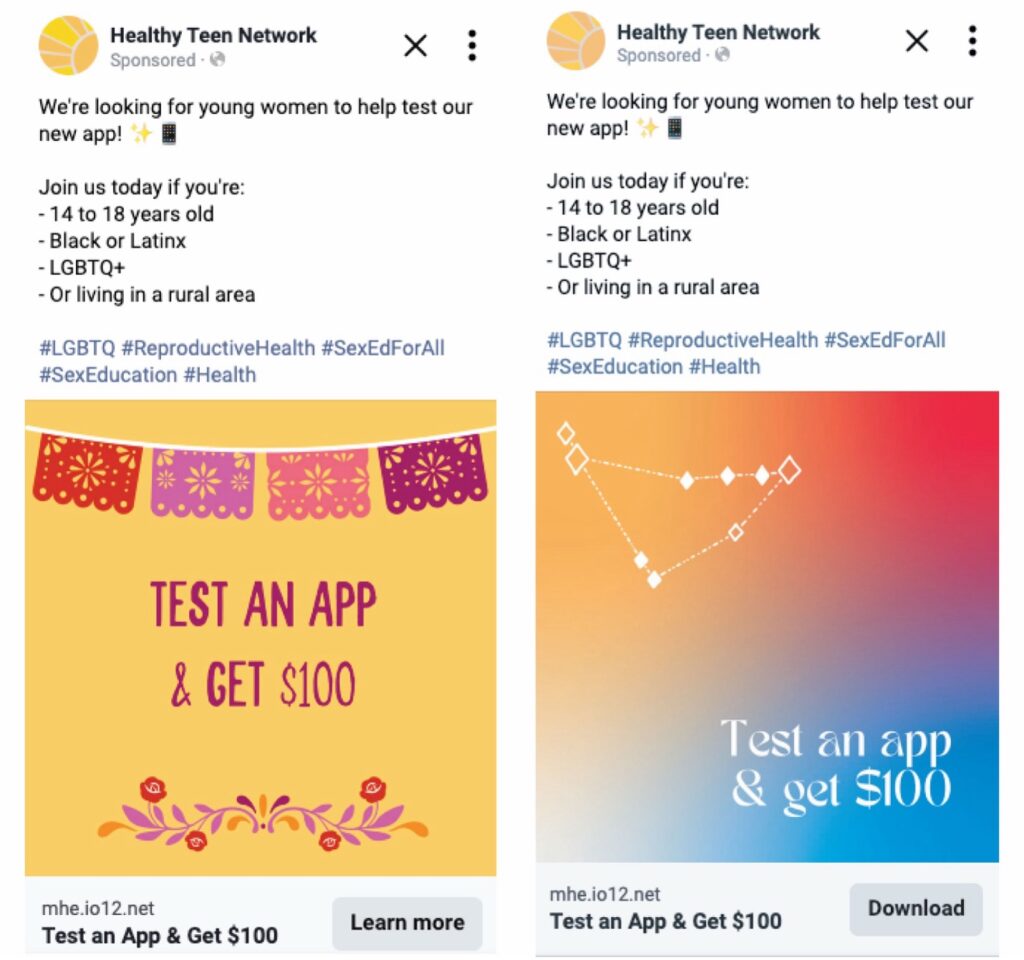
When developing graphics for ads, it’s important to look at the ads through the lens of your target audience (in our case, young people aged 14–18) and the platforms that you’ll be using to deploy your ads. For Facebook and Instagram, combined under the umbrella of Meta Ads, it’s best to create simple graphics with minimal text. Too much text may get your ad flagged, and Meta will not optimize the ad, which means it won’t reach the full breadth of your target group.
We found that using tailored imagery such as rainbow constellations and Spanish-inspired buntings was a subtle way to grab the attention of specific audiences. It’s also helpful for ads to have a clear ask and include a button with a direction for the user to take—for example, a link to a webpage or app download.
2. Explore new platforms
While graphic ads are still a great tool for digital recruitment, it’s also important to explore new platforms—that’s why we included TikTok in our youth recruitment for the first time. The biggest lessons we learned from our TikTok ads are to troubleshoot and test your ads prior to piloting and not to include any sexual and reproductive health (SRH) language in the caption or image.
Unlike Meta ads, where we could add hashtags like #SexEducation and #SexEdForAll, TikTok will not approve ads with SRH language. These restrictions mean you may have to get creative with your copy and use words that sound similar but avoid censorship, like #Seggs or #SeggsEd. Do some research and see what other creators in the SRH field are using.
You also want your TikTok video to be short and engaging. Try to include young people who look like your target audience, and as always, take advantage of trending music or audio by adding it in the background.
3. Allow time for troubleshooting
It’s not always smooth sailing with a social media ad campaign; occasionally, there will be delays as the ad platform processes and approves the ads, and you may also run into other technical roadblocks. Maybe people are having difficulty accessing the page you’re sending them to. Maybe the platform itself is experiencing an outage. When planning out your campaign, make sure to allot extra staff time for troubleshooting.
It’s also important to keep track of any ad disputes and appeals, as well as information about why the ad was denied by the ad platform. Where possible, you can adjust your ad to fit the limitations and ensure your next campaign adheres to the standards.
4. Monitor in real time
Once you click launch on an ad campaign, you unfortunately don’t get to sit back and relax. We recommend checking in on the campaign at least once a day to see how your ads are performing, and always be ready to change things in the moment. For example, you might find that an ad asset isn’t performing well, so it’s good to have another on hand that you can substitute, perhaps with more specific targeting.
5. Expect requirements and limitations to change
They say the only constant is change, and that adage is true of social media ad platforms as well.
They say the only constant is change, and that adage is true of social media ad platforms as well. Between the time that we piloted our initial ads in 2022 and finished our study recruitment in 2025, we saw vast changes in what ad platforms allowed.
For example, an element of our study involved recruiting young people living in specific geographic locations, but Meta made it so that we couldn’t choose both people under 18 and ZIP codes in our audience-targeting settings. We had to remain nimble and adjust to these changes, instead choosing to broaden our geographic reach.
By keeping up to date on the latest ad platform restrictions and finding alternatives if needed, you can minimize ad downtime and help ensure that you’re reaching the right audience.
Photo By: dlxmedia.hu
Megan Thomas is a Communications Manager at Healthy Teen Network. When she’s not thinking about how to support the health and well-being of young people, Megan enjoys watching movies, trying new restaurants with friends, exploring the neighborhood with her dog, and occasionally treading the boards at the local community theatre. Read more about Megan.