Julia Tallant

Jenn Rogers, MPH

Hannah Rackers, MPH

Lisa Kim, MPH
October 15, 2026
After a program wraps up, you might picture a hands-off evaluator delivering a final report to the implementation team, documenting outcomes of the program based on how everyone hoped the program might function. That model assumes you know in advance how a program will unfold. In innovation-focused initiatives, that assumption rarely holds true.
At In/Tend, an incubator hub, we support teams that are working to address challenges in adolescent sexual and reproductive health using human-centered design. Teams begin with a challenge they want to solve rather than a fully developed solution. As they engage with end users, gather feedback, and test ideas, their solutions evolve. New opportunities emerge, priorities shift, and unexpected lessons shape the path forward.
The work does not move in a straight line from inputs to impact, but instead, it adapts along the way.
The same is true for In/Tend itself. As we learn what teams need most, our coaching, learning opportunities, and evaluation tools shift accordingly. The work does not move in a straight line from inputs to impact, but instead, it adapts along the way.
That reality requires a different approach to evaluation, which is why we use developmental evaluation (DE): an approach built for complex, emergent environments. DE embeds learning into implementation, generating timely insights that help programs adapt, improve, and innovate in real time. As solutions evolve, key components and goals of innovations may shift, which means that intended outputs, outcomes, and measurement must be adjusted accordingly.
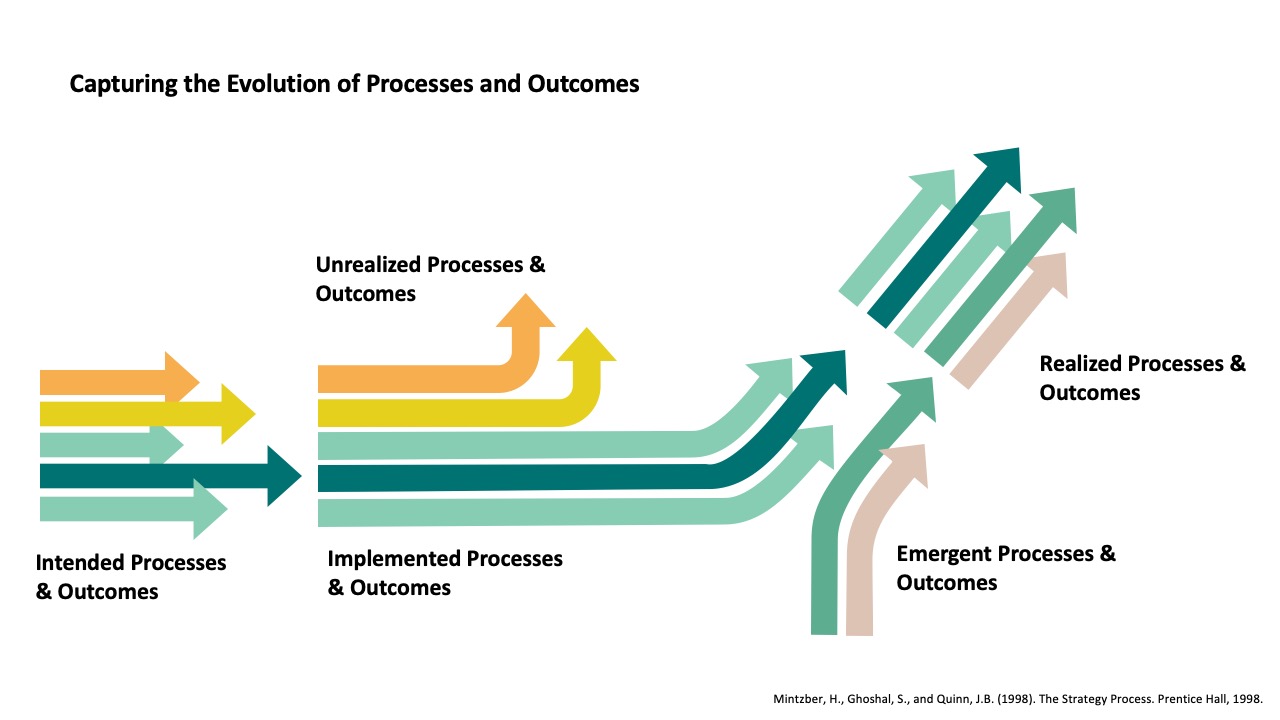
Figure 1 illustrates how DE differs from more traditional approaches. Programs often begin with intended processes and outcomes, but implementation might look different as programming unfolds; some planned activities continue as expected, others are adapted or left behind, or new processes and outcomes emerge. Rather than evaluating whether the original plan was implemented, DE intentionally captures this evolution, helping explain how and why change occurs.
Figure 1. Capturing the Evolution of Processes and Outcomes
Adapted from: Mintzber, H., Ghoshal, S., and Quinn, J.B. (1998). The Strategy Process. Prentice Hall, 1998.
What DE Looks Like in Practice
In In/Tend, DE is integrated into how we operate and learn. As an evaluation team, we work closely with implementation staff, revisit our learning agenda, and share findings quickly, so they can inform decisions. In practice, that looks like:
- Refining our learning agenda as the hub evolves. As our understanding of In/Tend deepened, we streamlined our original learning agenda from 13 questions to four, sharpening our focus on the hub’s overarching goals and the questions most useful for ongoing learning.
- Building on what we learn. When Cohort 1 participants identified a need for clearer understanding of the incubator structure and expectations to help them prioritize work and get the most out of the experience, In/Tend introduced a more structured onboarding process for Cohort 2. Evaluation findings from Cohort 2 showed that the revised approach helped strengthen early clarity and connection.
- Adapting in real time. For in-person trainings, we developed daily participant feedback surveys for the implementation team to understand teams’ needs, allowing them to adjust pacing, clarify content, and improve the experience from one day to the next.
Why It Matters
For In/Tend, adaptation is often evidence that learning is occurring rather than a sign that implementation is off track.
For In/Tend, adaptation is often evidence that learning is occurring rather than a sign that implementation is off track. DE helps capture that learning, understand why changes are being made, and ensure that insights are used to strengthen both the hub and the teams it supports. It also helps document how our work evolved, providing valuable lessons for future cohorts and the broader field.
Embedding evaluation into implementation has helped In/Tend move beyond measuring what happened to understanding how and why change occurs. In environments built around experimentation, adaptation, and innovation, evaluation is most valuable when it helps shape the work.
Photo By: yx z
The Child Trends evaluation team (Jenn Rogers, Hannah Rackers, Lisa Kim, and Julia Tallant) is a partner on the In/Tend Incubator. The team provides evaluation and learning support, working closely with the In/Tend team to collect and make sense of data, surface insights, and support ongoing learning and improvement. Learn more about Child Trends.