
FEBRUARY 5, 2026
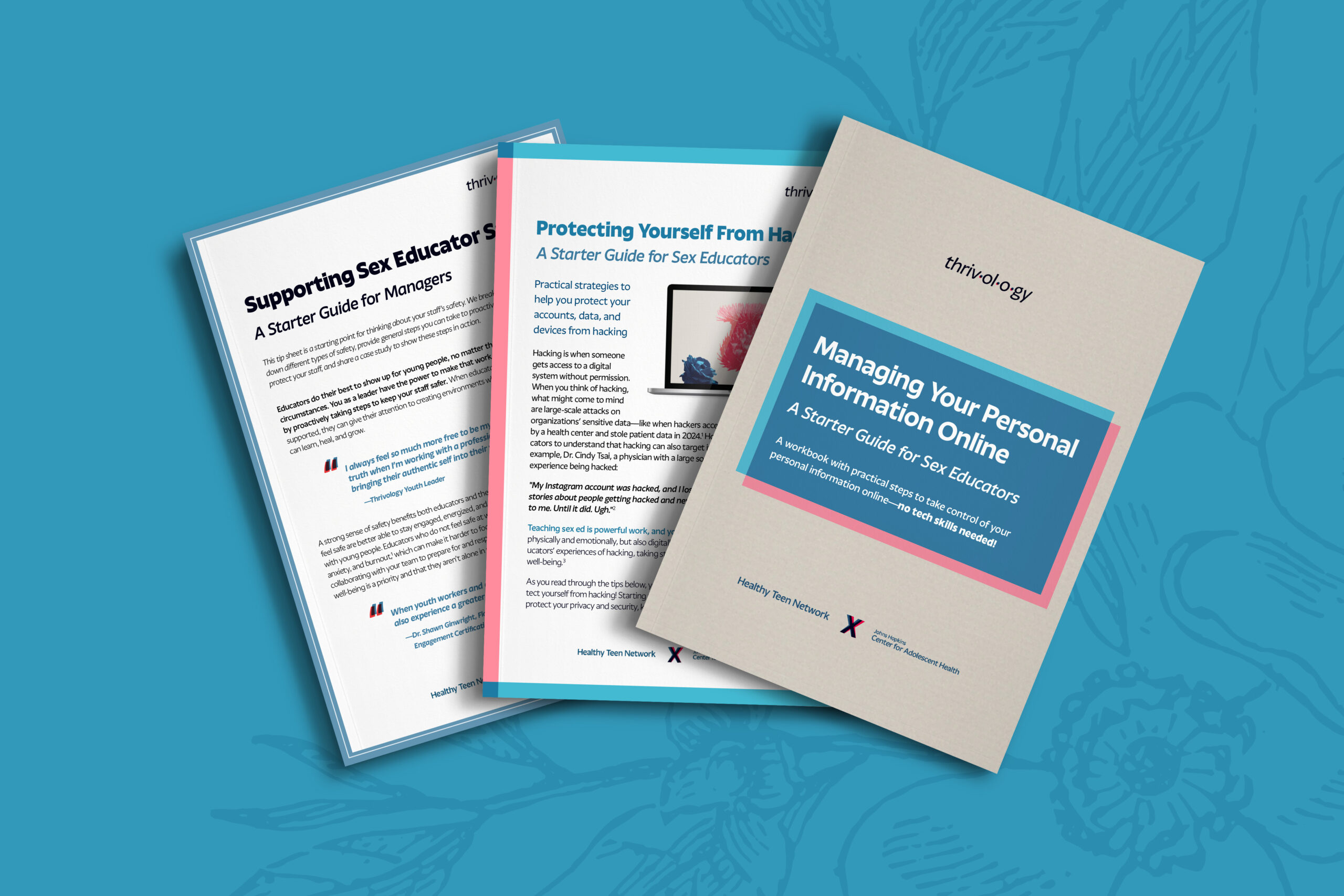
Sex ed is powerful work, and you deserve to feel safe doing it—that is the premise of our three new Thrivology resources: Supporting Sex Educator Safety, Managing Your Personal Information Online, and Protecting Yourself from Hacking.
Many sex educators are currently navigating uncertainty around the evolving safety risks they face and how they can protect themselves.
Many sex educators are currently navigating uncertainty around the evolving safety risks they face and how they can protect themselves. We sought out to create resources that would target sex educators’ real gaps and support needs, while also honoring the ways they and their managers are already working to protect their safety. And we knew the only way to achieve that goal was to center the voices of sex educators, managers, researchers, and other subject matter experts.
Interested in using the resources but want to learn more about how they were made? Curious about human-centered design as a way to partner with local youth-supporting professionals and design tools of your own? Read on for a brief breakdown of our design process as a case study of one way that collaborative design can happen.
Deciding to focus on sex educator safety
Thrivology resources address a wide range of topics within adolescent sexual and reproductive health (check out some others here!). Our first step is always to take an informed approach to choosing the topic to focus on.
We decided to focus on sex educator safety by brainstorming with project staff, then widening the circle to include input from our Research Alliance members and expert trainers at Healthy Teen Network, who work closely with sex educators.
A clear theme that our discussions surfaced is that these are uncertain times in the field of adolescent sexual and reproductive health.
A clear theme that our discussions surfaced is that these are uncertain times in the field of adolescent sexual and reproductive health. A lot of sex educators are concerned about their safety and are unclear about what specific risks they face.
Some of our project team had specifically heard calls from the field for digital safety support: Sex educators can see that heated debates about sex ed are gaining increased attention online, but they don’t feel that they have the tech expertise and guidance to protect themselves. We also did background research that found that resources for supporting sex educators’ safety is basically nonexistent.
From these conversations, we saw a clear opportunity to support sex educators’ well-being and enable them to better show up for young people.
Understanding sex educators’ and managers’ needs
For our field research, we took a two-pronged approach of a survey and interviews.
Digital safety survey
Because we had already heard a direct need for digital safety tools, we decided to create a targeted survey aimed at filling gaps in information about sex educators’ experiences and concerns, rather than opening up new areas to explore. Thirty-five eligible respondents took the survey, including 15 educators and 7 managers. Over half of them were very or somewhat concerned about their digital safety, which aligned with our understanding. Others shared confusion about whether they should be worried.
“I do think there’s some reason to be concerned, but I haven’t put much thought into my concern personally. I do know other educators in my field and area who have been doxed, but I do not sense imminent threat of that. I should possibly be more concerned than I am.” -Digital safety survey participant
While many respondents expressed concerns about not being tech-savvy enough to protect themselves, almost everyone was able to name at least one way they were keeping themselves safe! The two main strategic areas were doxing and hacking protection. The survey also validated our belief that sex educators need more support for their digital safety. Over half had not tried to use any resources to improve their digital safety, and only 7% felt that existing resources were working well to keep them protected.
Safety interviews
In addition to digital safety, we knew we wanted to create a suite of safety-focused resources. We therefore took a more expansive field research approach to learn about what supports sex educators need for their overall safety.
We led six 60-minute interviews with five youth-supporting professionals and one policy expert, from across the country. For one portion of the interview, we created an interactive Miro board structure to encourage participants to get specific about their concerns.
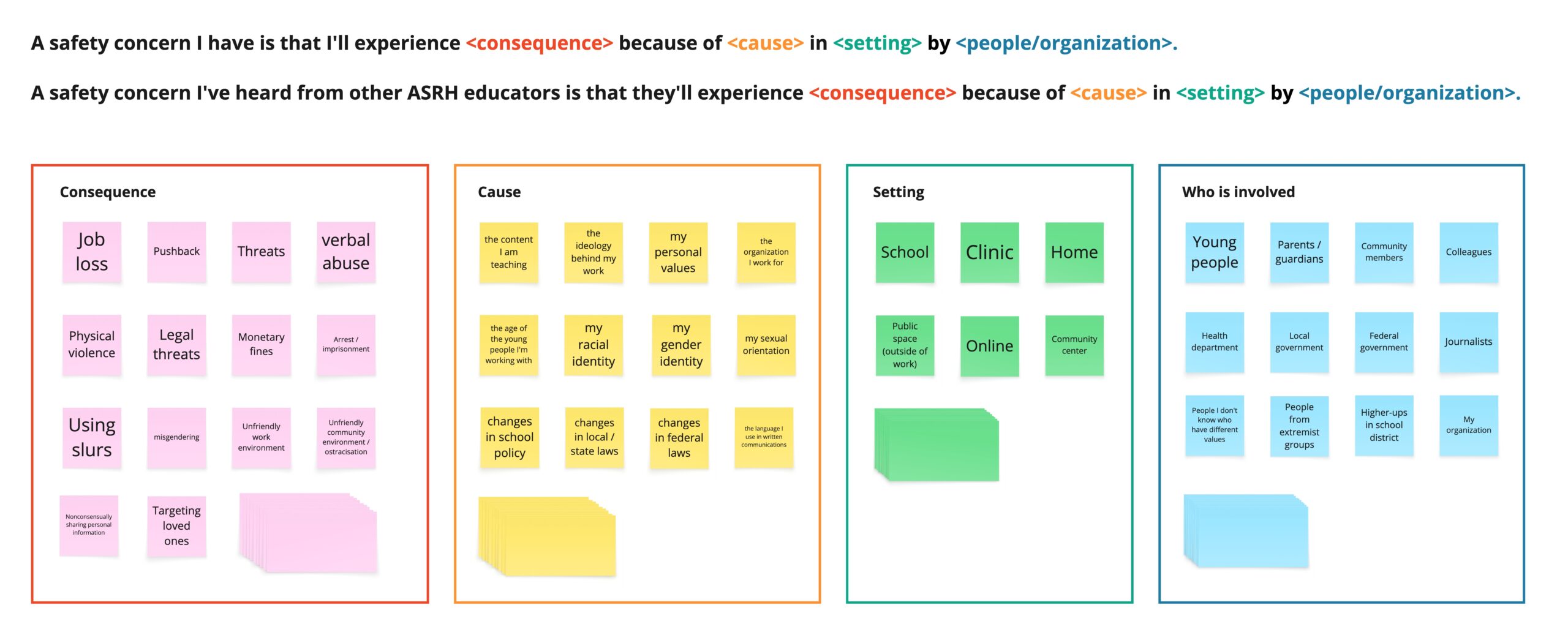
After doing the first round of making sense of our interview data, we decided to focus on managers of sex educators as our main audience. We heard that sex educators are under a range of pressures right now, so feeling like their manager has their back makes a huge difference. An organization’s leadership can play a key role in putting policies and practices into place that can help keep their staff safer. We then led three additional interviews with managers to understand how they’re approaching safety concerns among their staff.
This information-gathering stage was crucial for informing our design process to center sex educators’ needs and existing strategies to keep themselves safe.
Using what we learned to come up with resource ideas
Our next step was to transform what we had heard into questions and goals that would spark our brainstorming of possible resources, and from there, we chose specific resource ideas to try out. For each set of data, we grouped information into broader themes and wrote up findings based on those patterns.
From survey data, we came up with a design objective to increase sex educators’ confidence in understanding and protecting themselves against key digital safety threats. We decided to focus on doxing and hacking protections to build on what sex educators shared that they were already doing to keep themselves safe online.
Using our interview data, we found a pattern of four steps for managing staff safety procedures and supports:
- Proactively considering staff safety
- Assessing risks and supporting staff in assessing risks
- Taking action to update policies and procedures
- Adapting after an incident occurs
For our resource aimed at managers, we decided to create a foundational resource focused on step 1—getting manager buy-in and increasing understanding of different types of safety.
Trying out possible solutions
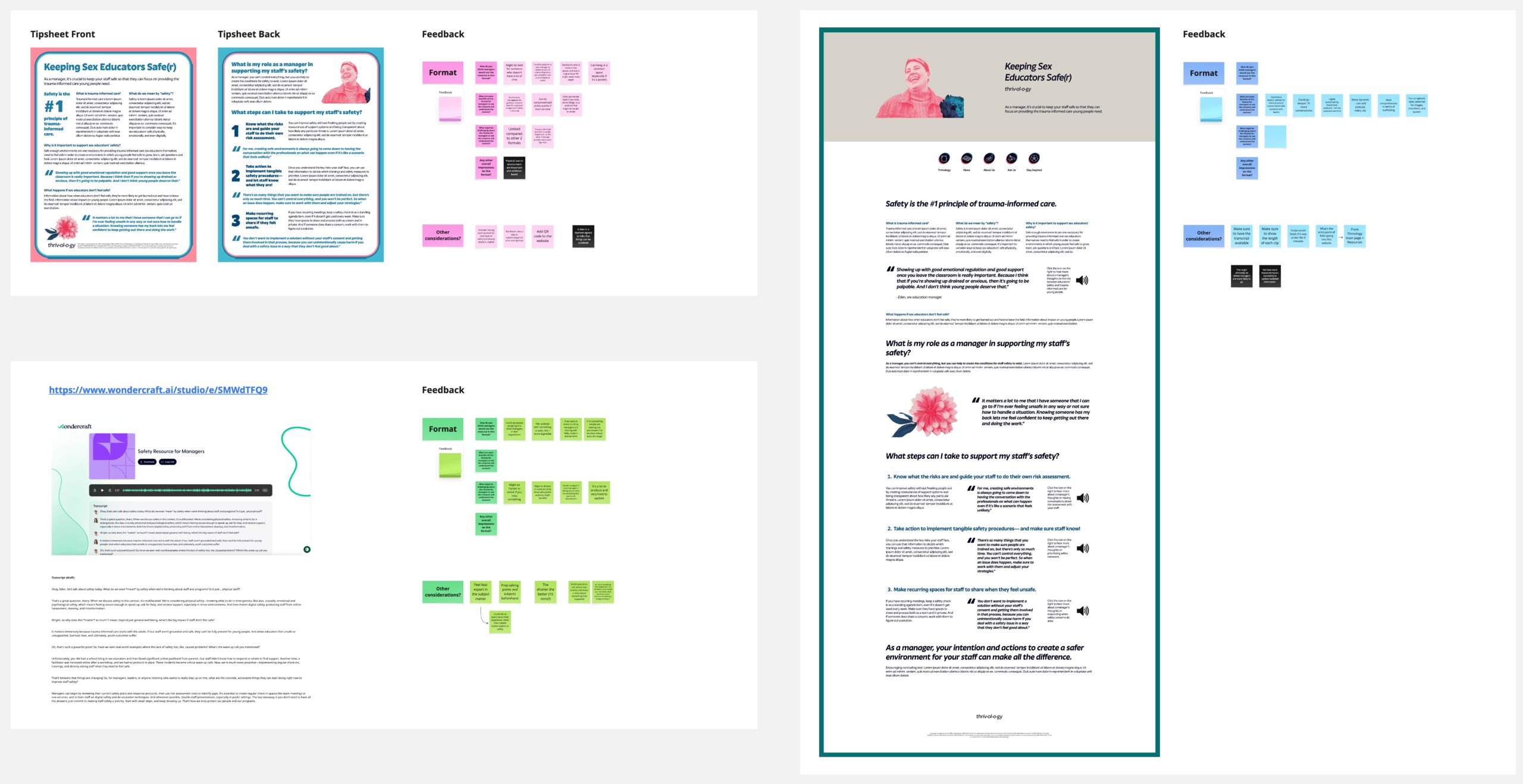
After picking resource ideas, we moved into creating quick prototypes, which are initial resource versions that are built out just enough to spark discussion about key questions. These prototypes allowed us to try things out and get early answers, rather than spending a ton of time or energy on an untested idea. We met with at least one Research Alliance member for each resource to get feedback on formats and content.
Below is a screenshot of three prototypes for our resource aimed at managers of sex educators, alongside notes from a meeting with two Research Alliance members.
Getting iterative feedback throughout development
Finally, we involved our Research Alliance members throughout the process of developing the resources, in addition to doing quality assurance reviews within our project team. All three resources first went through a usefulness review; this review focused on questions like:
- Is the purpose of the resource clear?
- How well do you believe this resource would meet the needs of youth-supporting professionals?
- Is the content relevant and actionable?
After we made revisions, Research Alliance members shared their thoughts in a usability review, covering topics such as whether it’s easy to find the information you’re looking for, whether it’s organized clearly, and whether the language is accessible.
While involving youth-supporting professionals during the earlier stages of the design process was crucial for determining that we were creating the right resources, their involvement near the end helped us make sure that the resources included the right information in a usable format.
Conclusion
A key piece of advice in Supporting Sex Educator Safety: A Starter Guide for Managers is to collaborate with your staff to create solutions grounded in their needs, concerns, and goals. We worked hard to embody this practice ourselves when creating these safety resources. By incorporating perspectives from sex educators, managers, and other subject matter experts, we created three practical resources that address real needs and provide actionable guidance.
But don’t just take our word for it—try them out for yourself!
Charlie Blue Brahm likes to meander through a topic, asking “why” until they can see a full and vibrant picture, accepting complexity and contradiction rather than flattening people or situations for convenience’s sake. This worldview has taken them through a path of learning first how to understand and create technology, then how to understand and organize people who create technology, and now how to understand and design for the people who use and are affected by technology. Read more about Charlie Blue.